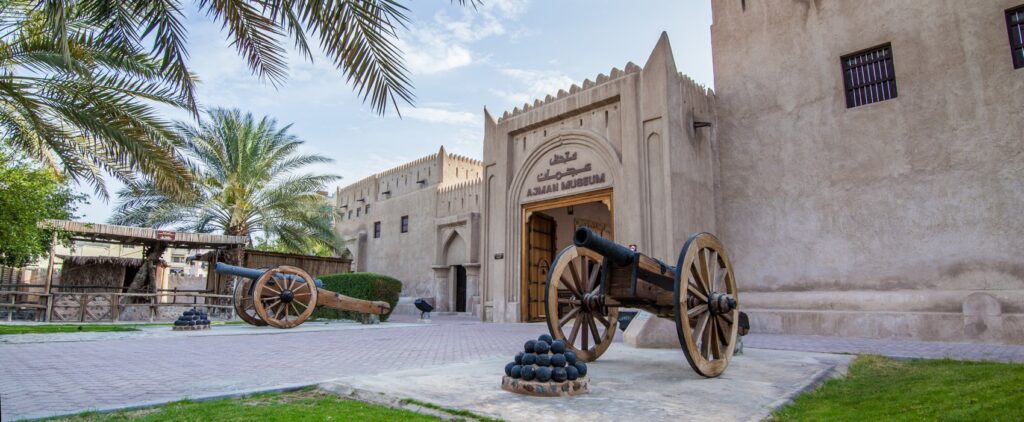
Ajman Museum
An 18th-century fort on the central square, holding Ajman's oldest finds
Ajman Museum occupies the fort that stood at the centre of the emirate’s life for close to two centuries. Built in the 1700s, the building served as the ruler’s residence until 1970 and opened as a museum roughly a decade later, which means the architecture is part of the exhibit: thick defensive walls, a fortified gateway, and rooms arranged around the shaded courtyard that kept the fort liveable through the summer. It sits on the east side of the central square in the Al Bustan area, a short walk from the Corniche and next door to the Gold and Traditional Souqs.
What Is on Display
The collection runs from centuries-old manuscripts and weaponry to scale models of the wooden dhows that carried Ajman’s trade, alongside reconstructions of the irrigation systems that made settlement possible. The most significant holding came out of the ground at Al Muwaihat, where an excavated cemetery yielded pottery and funerary jewellery dated to as early as 3000 BC. A further section is given over to the pearling trade that underpinned the regional economy before oil. Display labels are in both Arabic and English.
Visiting
The museum opens Saturday to Thursday from 8:00am to 8:00pm, and on Friday from 2:30pm to 8:00pm. Drive time from Dubai is a little over an hour via Sheikh Mohammed Bin Zayed Road, and a City Sightseeing bus stop is placed close by. For enquiries, call 06 711 6675 or email ajmanmuseum@ajmantourism.ae.
- 18th-century fort, the ruler's residence until 1970
- Traditional Emirati fort architecture
- Al Muwaihat finds dating to 3000 BC
- Manuscripts, weaponry and dhow models
- Dedicated pearl trade section
- Labels in Arabic and English
What is included
- Return hotel transfers
- Museum entry
- Guided walk-through of the main galleries
- Bottled water
Not included
- Meals and refreshments
- Personal purchases at the adjacent souqs
- Gratuities